
Best Community Tourism Villages in Sri Lanka: Experience Daily Village Life
Discover the best community tourism villages in Sri Lanka, from Galenbindunuwewa’s reservoirs and village life to local food, kayaking and camping.
Before six in the morning, the villages around Galenbindunuwewa are already beginning to stir.
A thin veil of mist still rests above the reservoir. Somewhere beyond the paddy fields, the bell of a farmer’s bicycle breaks the early silence. From a nearby garden comes the sound of firewood being arranged beneath a clay stove, followed by the faint scent of smoke drifting into the cool morning air.
Birds call from a roadside neem tree. White egrets standing among the rice fields rise together as the first sunlight reaches the land. When a breeze moves inland from the water and passes through the young rice plants, the entire field appears to ripple.
This is not a performance arranged for visitors.
It is an ordinary morning in Galenbindunuwewa.
For travellers searching for the best community tourism villages in Sri Lanka, the value of an experience like this is not found in visiting a single attraction. It comes from seeing how reservoirs, farmland, forests and local communities remain connected through everyday life.
Galenbindunuwewa is one of the places where this relationship can still be observed at a natural pace. Within the wider community, Hurulu Nature Park brings together reservoir landscapes, wildlife habitats, local knowledge and nature-based activities, offering visitors a closer connection with rural Sri Lanka.
What Is a Community Tourism Village?
A community tourism village is not simply a place where visitors are shown a few rural scenes before being moved on to the next attraction.
The experience is shaped around local knowledge, livelihoods, food traditions and the surrounding environment. Rather than treating village life as a display, community tourism creates opportunities for travellers to understand how people live, work and interact with the land.
A local guide explaining the changing conditions of a reservoir, a farmer describing how water reaches the paddy fields, a family preparing a home-cooked meal, or young residents organising kayaking and camping activities can all be part of community-based tourism in Sri Lanka.
An important aim is to keep more of the economic value of tourism within the local area. Local guides can earn an income from sharing their knowledge, families who prepare traditional meals can gain new opportunities, and young people can develop tourism services without necessarily having to leave their communities.
Community tourism is therefore about more than giving visitors an enjoyable day. When organised responsibly, it can connect travellers, local livelihoods and the natural environment in a way that benefits the wider community.
Why Visit the Best Community Tourism Villages in Sri Lanka?
Sri Lanka’s villages offer something that busy sightseeing routes often cannot: time to observe the small details of everyday life.
You may see farmers cycling towards their fields before the heat of the day, children waiting beside a village road for the school bus, or families beginning their morning beside wood-fired clay stoves. None of these moments has been created for tourism, yet together they reveal how rural communities function.
The most meaningful authentic community village experiences are often unhurried. They allow visitors to listen, ask questions and understand the relationship between people and their surroundings rather than simply photographing a rural landscape.
Community-led travel can also create a more direct connection between tourism spending and local livelihoods. Choosing locally organised activities, community guides, village meals and small regional services may help more of the value generated by tourism remain within the destination.
For international travellers, these experiences provide a different perspective on Sri Lanka: one shaped not only by famous landmarks but also by working landscapes, local knowledge and ordinary human moments.
1. Galenbindunuwewa: Village Life Shaped by Reservoirs, Paddy Fields and Community
As the main road gives way to smaller village lanes around Galenbindunuwewa, the landscape gradually changes.
Traffic noise begins to fade. Paddy fields and home gardens appear beside the road, while mature neem, tamarind and palu trees provide patches of shade. The surroundings feel less hurried, but daily life is already in motion.
In the morning, farmers travel towards their fields by bicycle or carry tools for the day’s work. Schoolchildren wait beside the road for buses. Chickens wander freely through gardens, and the aroma of breakfast cooking over a clay stove sometimes reaches beyond the boundaries of a family home.
Life in Galenbindunuwewa is closely connected to its reservoirs.
The water supports paddy cultivation, provides livelihoods for fishing families, and serves cattle and wildlife. In the evening, the reservoir also becomes a place where local people can spend time beside the water after the day’s work, enjoying the cooler air.
Visitors do not come here to watch a separately staged “village show”. What they encounter is daily life shaped over generations by water, agriculture and the surrounding natural environment.
Daily Village Life in Galenbindunuwewa
Farmers often begin their work before sunrise.
Some inspect the channels that carry water towards the fields, while others prepare equipment for the day ahead. The rhythm of village life changes with the agricultural season, and the appearance of the land changes with it.
During the growing period, young rice plants spread a deep green colour across the fields. Drops of morning dew rest on the leaves and begin to shine when the sunlight reaches them.
The harvest season brings a different landscape. Ripened rice bends gently in the wind, turning the fields from green to shades of gold. The sound of harvesting machinery may travel across the open land, while some families work together to collect, dry and store the harvest.
When access is arranged with the permission and guidance of local residents, a visit to a working farm can reveal how water is distributed from reservoirs to agricultural land and how farmers adjust their work according to weather and seasonal conditions.
This is traditional village life in Sri Lanka as part of an active community rather than a recreated attraction.
What You’ll Experience at Hurulu Nature Park
Galenbindunuwewa is a large rural area made up of communities, farmland, reservoirs and natural landscapes.
Hurulu Nature Park is a community-based nature experience that has grown from within this setting. It connects the reservoir environment with local knowledge and activities such as guided kayaking, nature observation and camping.
Its value comes from being connected to the wider community rather than separated from it as a stand-alone tourist attraction.
The route towards a kayaking location may pass between paddy fields and village gardens. When the guide is someone who lives locally, their understanding of the reservoir comes from daily observation: changing water levels, seasonal weather, bird activity and the behaviour of the surrounding landscape.
That knowledge cannot always be learned from a guidebook. It develops through living beside the water and observing it over time.
Sunrise Kayaking on a Quiet Village Reservoir
Before sunrise, the reservoir is often at its quietest.
A light mist may remain above the surface, while the dark outlines of trees are reflected in the water. The air is cooler, and the landscape seems to wait for the first light.
Before entering the water, visitors put on life jackets and receive guidance on paddling techniques and reservoir safety. Once the kayak begins moving away from the shore, the soft sound of the paddle entering the water may be the only interruption to the silence.
Gradually, birds begin to call. Egrets rise from the water’s edge, while cormorants disappear beneath the surface in search of food.
The eastern sky changes slowly, moving from pale pink towards orange and gold. As the light spreads across the reservoir, the landscape becomes clearer with every passing minute.
Stopping the kayak for a moment allows you to watch the day begin without rushing towards the next activity. It is a simple experience, but one that reveals how different a familiar event such as sunrise can feel when seen from the middle of quiet water.
Sunset Kayaking in Galenbindunuwewa
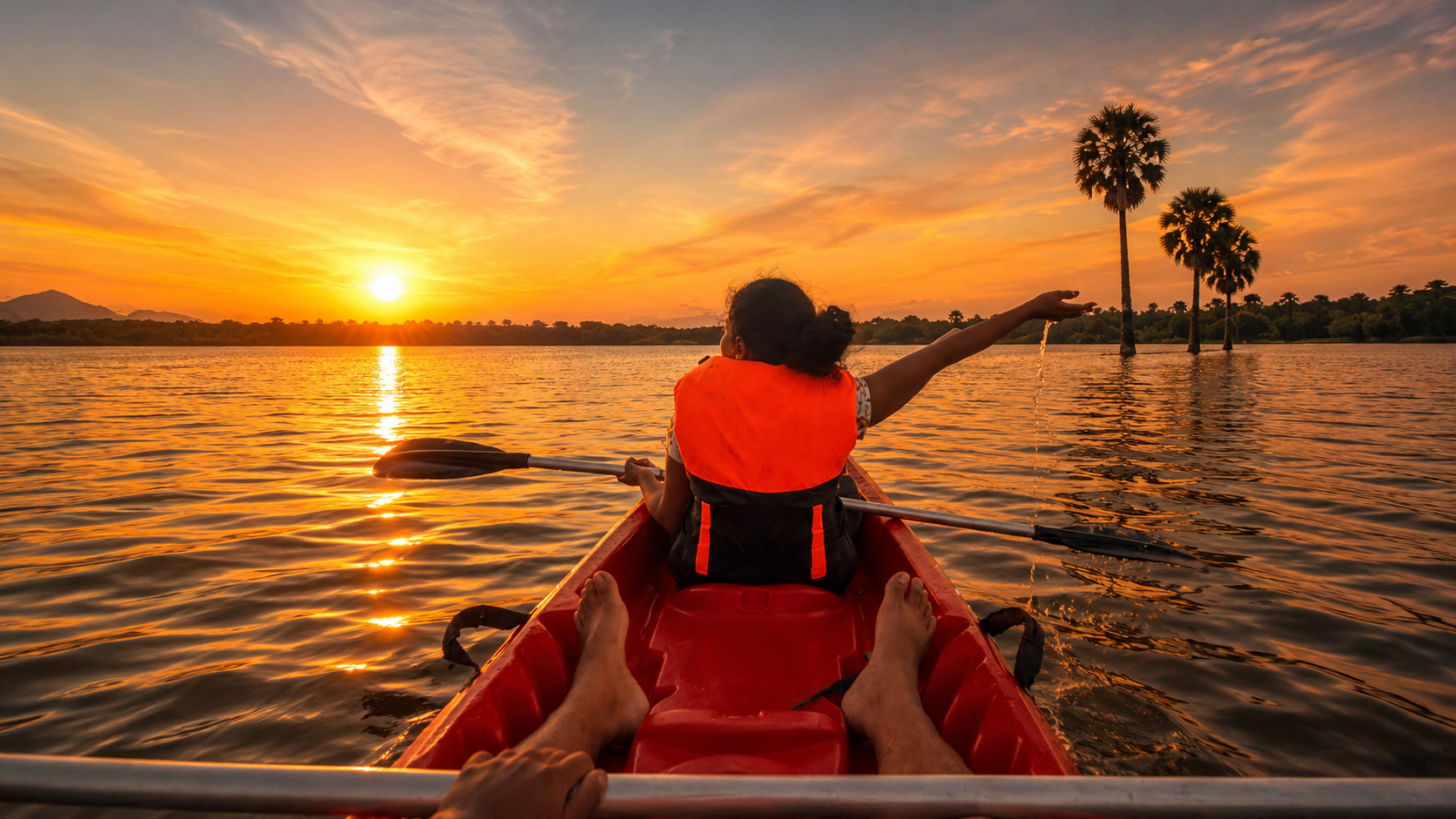
The reservoir has a different character in the late afternoon.
As the heat begins to ease, cooler air moves across the water. Cattle may gather near the shore to drink, while birds travel towards their evening roosts.
The western sky shifts from yellow to orange and deeper shades of red. Reflections stretch across the water, and the shadow of the kayak lengthens as the sun moves closer to the horizon.
There are moments when it feels natural to stop paddling and allow the kayak to drift. Apart from small ripples moving across the surface, very little seems to change.
As the sun disappears behind the trees, the final orange light remains on the reservoir for a little longer.
It is the kind of moment that may feel more valuable as a memory than as another photograph.
Wildlife Watching from the Water
Some reservoirs around Galenbindunuwewa are located close to forests and natural wildlife habitats.
During a kayaking experience, visitors may see cormorants, egrets and other waterbirds. The species and level of activity vary according to the season, weather and conditions around the reservoir.
At certain times, there may also be an opportunity to observe wild elephants approaching distant areas near the water. However, elephants move freely through their natural environment, so sightings should never be expected or guaranteed.
If an elephant is present, approaching it is not the purpose of the experience.
Visitors should follow the instructions of experienced local guides, remain quiet and observe from a safe distance. Kayaks and other activities should never block an animal’s route or interfere with its natural behaviour.
Responsible wildlife encounters are defined by distance and restraint. Allowing wildlife to move without disturbance is more important than obtaining a closer photograph.
Camping Under a Million Stars
After sunset, the surroundings of Galenbindunuwewa gradually become quieter.
As the final light disappears, insects begin calling from among the trees. A night bird may be heard in the distance, while cool air moves inland from the reservoir and passes through the campsite.
Away from strong city lights, more stars become visible as the night deepens. One by one, they fill the sky until there seem to be too many to count.
Sitting in a camp chair with a warm cup of tea, the sky can appear larger than it does at home. The crackle of wood from a safely managed campfire, the steady sound of insects and the wind moving through the trees create a natural rhythm around the campsite.
The value of the “Under a Million Stars” experience is not simply the number of stars overhead.
It is the chance to spend time away from city lights, phone screens and the constant movement of everyday routines. In that setting, visitors can rediscover how quiet a night can be.
Local Culture and Everyday Connections
The culture of Galenbindunuwewa is not confined to ceremonies or performances. It can be found in ordinary routines: the way families work with the agricultural seasons, the knowledge shared between generations, and the continuing relationship between reservoirs and village livelihoods.
Visitors may learn more through conversation than through formal explanation. A farmer describing the movement of water through an irrigation channel or a local guide explaining changes in the reservoir can offer insight into the practical knowledge that supports daily life.
Respect is essential when entering these spaces. Farms, gardens and village homes are working and living environments, not public attractions.
Meaningful rural community experiences in Sri Lanka depend on listening, asking permission and allowing local people to decide how their knowledge and daily lives are shared.
Village Food: A Meal Connected to the Community
A rural experience in Galenbindunuwewa feels more complete when it includes a locally prepared meal.
Red rice may be served with coconut sambol, dhal, pumpkin or aubergine curry, and mallung prepared from freshly gathered leafy greens. When reservoir fish is available, a fish curry cooked with goraka, chilli and local spices may also be included.
The faint smoky aroma from a clay stove and the freshness of newly prepared coconut sambol give the meal a character that is difficult to separate from its setting.
Yet the most meaningful part of the experience is not only what appears on the plate.
The garden where vegetables were grown, the family who prepared the meal and the conversations shared while it is served are also part of the experience. Food provides a natural connection between visitors and the community without requiring a staged performance.
When meals are purchased directly from local families, part of the traveller’s spending reaches the people who prepared the food. This is one of the practical ways that sustainable village tourism in Sri Lanka can support local livelihoods.
How Community Tourism Supports Galenbindunuwewa
When organised carefully, the benefits of community tourism do not have to remain with a single tourism business.
Local young people may find opportunities as kayaking guides, nature guides or camping assistants. Families who prepare village meals can earn additional income, while local drivers, farmers, small shops and regional producers may also benefit from visitors spending time in the area.
Community tourism can encourage local knowledge to remain valuable. Familiarity with reservoirs, weather, wildlife and rural landscapes becomes an important part of the visitor experience rather than something overlooked by conventional tourism.
When more tourism income remains within the area, travel has greater potential to support community life rather than disrupt it.
This is the wider purpose of local community tourism projects: creating experiences that are meaningful for travellers while supporting the people and environments that make those experiences possible.
Other Community Tourism Villages and Rural Areas in Sri Lanka
Galenbindunuwewa offers a close connection with reservoir landscapes and agricultural life, but other parts of Sri Lanka provide different opportunities to experience rural communities and local culture.
Each destination has its own environment, livelihoods and pace. Travellers should look for locally organised, respectful experiences rather than expecting every village to offer the same activities.
Meemure: Village Life Among Mountains and Forests
The road towards Meemure gradually becomes narrower as it enters the Central Highlands.
Travelling between forested slopes, mountain scenery and small streams creates a growing sense of distance from the country’s busier urban areas. By the time the village is reached, the surrounding landscape feels enclosed by mountains and greenery.
Home gardens may contain pepper vines, jackfruit trees and breadfruit trees. Visitors can explore natural trails with local guides and learn more about everyday life within this mountain environment.
Choosing locally guided activities can provide a more respectful and informed way to experience the landscape.
Villages Around Mahiyanganaya: Paddy Fields and Local Culture
In the early morning, mist may rest above the paddy fields around Mahiyanganaya.
Farmers begin working while white egrets move behind them through the fields in search of food. The landscape is open, agricultural and closely connected to seasonal routines.
For travellers interested in farming, village food and regional culture, rural communities around Mahiyanganaya can offer a different perspective on life beyond Sri Lanka’s main visitor routes.
Experiences should be arranged with local guidance so that visits respect working farms, homes and community spaces.
Estate Communities Around Haputale: Tea Fields and Mountain Mist
Morning roads around Haputale may disappear into mist.
Walking beside tea fields, visitors can sometimes smell the damp leaves while the distant sound of a train travels between the hills. The atmosphere is very different from the dry-zone reservoir landscapes of Galenbindunuwewa.
Travellers interested in learning about tea cultivation and daily life within estate communities should choose experiences organised with knowledgeable local guides.
Responsible tourism in these areas means recognising that tea landscapes are not simply scenic viewpoints. They are also places where communities live and work.
Best Time to Visit Galenbindunuwewa
The most rewarding time to observe daily village life around Galenbindunuwewa is generally between 5.30 am and 9.00 am.
Temperatures are cooler, and visitors may see mist above the reservoirs, active birdlife and farmers beginning their morning work. Sunrise kayaking also allows travellers to experience the landscape before the day becomes warmer.
For sunset kayaking, the period from around 4.30 pm until sunset can offer softer light and cooler conditions.
After rainy periods, paddy fields and surrounding vegetation may become intensely green. During drier periods, the landscape can shift towards gold and brown, while wildlife activity near water sources may also change.
Kayaking and camping depend on weather, wind, reservoir water levels and local safety conditions. Always confirm current conditions, meeting arrangements and activity availability before travelling.
How to Get to Galenbindunuwewa
Galenbindunuwewa is located in the Anuradhapura District of Sri Lanka’s North Central Province.
Anuradhapura is a convenient starting point for exploring the area. From the city, travellers can continue by private vehicle, hired van or with a driver familiar with local roads.
After reaching the main town, access to Hurulu Nature Park and nearby reservoir experiences may involve travelling along smaller village roads.
Road conditions can change during rainy periods. Confirm the correct route, transport arrangements and meeting location with the activity provider before beginning the journey.
How Long Should You Stay?
Allow approximately two or three hours for a sunrise or sunset kayaking experience, including preparation and time beside the reservoir.
If you want to combine kayaking with a village visit and locally prepared food, consider setting aside half a day or a full day. This provides more time to experience the area without moving quickly between activities.
Travellers who want to combine farming landscapes, village food, sunset and the “Under a Million Stars” camping experience should consider staying for at least one night.
A slower visit often creates more opportunities for genuine interaction and a deeper understanding of the community.
What to Bring
Lightweight and comfortable clothing
A hat and suitable sun protection
A refillable water bottle
Quick-drying clothes for kayaking
A waterproof protective bag for phones and cameras
A lightweight long-sleeved layer for camping
Closed footwear
A torch
Any required personal medication
Binoculars for bird and wildlife observation
Responsible Travel Tips
Galenbindunuwewa is not simply a backdrop for travel photographs.
It is a living community where people work, children travel to school, farmers manage their land and families continue their daily routines. Visitors should experience the area with patience and respect.
Ask permission before entering farms, home gardens or private land.
Request consent before photographing local residents.
Follow local guides’ safety instructions during kayaking and wildlife encounters.
Never feed wild animals or attempt to move closer to them.
Do not block wildlife routes or disturb animals for photographs.
Take all rubbish away from reservoir banks, campsites and village roads.
Carry a refillable water bottle where practical.
Choose local guides, locally prepared meals and small community services.
Avoid treating ordinary village activities as performances.
Allow residents to decide what parts of their lives and knowledge they wish to share.
These choices help support responsible tourism villages in Sri Lanka while protecting local privacy, livelihoods and natural environments.
Nearby Attractions and Experiences
Galenbindunuwewa can be included in a wider journey through the Anuradhapura District and Sri Lanka’s North Central Province.
Travellers may combine a village experience with time in Anuradhapura before continuing towards other rural landscapes in the region. Reservoirs, agricultural areas and smaller village roads provide opportunities to see a quieter side of the province.
Rather than attempting to visit too many places in one day, allow enough time for the journey between destinations. Rural travel is often more rewarding when the schedule leaves space for unexpected conversations, changing weather and time beside the water.
Frequently Asked Questions
What are the best community tourism villages in Sri Lanka?
The best destination depends on the type of rural experience you want. Galenbindunuwewa offers reservoir landscapes, paddy farming, kayaking, village food and community-connected nature experiences. Meemure provides a mountain and forest setting, while rural areas around Mahiyanganaya and Haputale offer different agricultural and cultural landscapes.
What is community-based tourism in Sri Lanka?
Community-based tourism connects visitor experiences with local knowledge, livelihoods, food and natural environments. Activities may involve local guides, village families, farmers and community organisers, allowing more tourism value to remain within the destination.
Is Galenbindunuwewa an authentic village experience?
Galenbindunuwewa is a living rural community rather than a village attraction created solely for tourists. Visitors may observe daily agricultural life, explore reservoir environments and join locally connected activities while respecting private land and community routines.
What can visitors experience at Hurulu Nature Park?
Depending on local conditions and availability, experiences may include guided sunrise or sunset kayaking, nature observation, birdwatching, village food and camping beneath the night sky. Activities can change according to weather, water levels and safety conditions.
Can visitors see wild elephants while kayaking?
Wild elephants may occasionally be observed from a distance near some reservoir environments, but sightings cannot be guaranteed. Visitors must follow local guides’ instructions, remain at a safe distance and avoid disturbing or approaching wildlife.
Is Galenbindunuwewa suitable for responsible travellers?
Yes. Travellers can support the local community by choosing local guides, village-prepared meals and small regional services. Visitors should also ask permission before entering private land or photographing residents and should avoid disturbing wildlife.
How much time should I spend in Galenbindunuwewa?
Allow two or three hours for a kayaking activity. Set aside half a day or a full day if you want to include village experiences and local food. An overnight stay is more suitable for travellers who want to add sunset activities and camping.
What should I bring for a village and kayaking experience?
Bring comfortable clothing, sun protection, a refillable water bottle and quick-drying clothes for kayaking. A waterproof bag is useful for electronics. For camping, bring closed footwear, a torch, a lightweight long-sleeved layer and any personal medication.
Conclusion: Discover Daily Village Life Through Community Tourism
The best community tourism villages in Sri Lanka are memorable not because they offer the largest attractions, but because they allow travellers to notice the details of everyday life.
In Galenbindunuwewa, that memory may begin with the bell of a farmer’s bicycle travelling through the morning air. It may be the faint smoky scent of food cooking on a clay stove or the sight of sunlight reaching a mist-covered reservoir.
It may come from paddling quietly as the eastern sky turns gold, drifting across the water beneath the final orange light of sunset, or listening to the wind move through the trees beneath a sky filled with stars.
Galenbindunuwewa is the wider community that connects these experiences.
Hurulu Nature Park has grown from within that setting, bringing together reservoirs, nature, local knowledge and community-connected travel experiences.
For travellers who want to do more than observe daily village life from a distance, Galenbindunuwewa offers an opportunity to experience it slowly and respectfully. It is not simply somewhere to visit; it is a living community whose landscapes, livelihoods and stories remain closely connected.